

There’s something quietly powerful about the first hour of the day. Before the emails land, before the commute begins, before the world makes its demands — there’s a window of time that belongs entirely to you. How you use it, it turns out, matters far more than most people realise.
Morning rituals have moved well beyond the realm of wellness trends and productivity gurus. Research in psychology, neuroscience, and behavioural science increasingly points to the same conclusion: the habits we practise in the morning don’t just set the tone for a single day — they shape our mental health, emotional resilience, and long-term wellbeing in profound ways.
This isn’t about waking up at 4am or following a rigid 27-step routine. It’s about understanding why consistent morning habits work so well, and how even small, intentional changes can create lasting transformation.
What Science Says About Morning Routines and Mental Health
The connection between daily routine and mental health is well-established. According to research published by UCLA Health, predictable daily routines help regulate the body’s internal clock, stabilise mood, reduce anxiety, and improve sleep quality. When our days have structure, our nervous systems feel safer — and that sense of safety is the foundation on which everything else is built.
The National Alliance on Mental Illness (NAMI) highlights that structured routines are particularly beneficial for people managing depression, anxiety, and other mental health conditions. But the benefits aren’t limited to those with diagnosed conditions. For most people, routines simply reduce the cognitive load of daily decision-making — a phenomenon researchers call decision fatigue.
Every decision we make throughout the day depletes a finite pool of mental energy. By automating the early hours of the day through consistent rituals, we preserve that energy for the moments that truly need it. This is partly why so many high-performing individuals — from athletes to artists — are notoriously protective of their mornings.
The Psychology Behind Daily Routines
From a psychological perspective, routines work because they create a sense of control and predictability. When life feels chaotic or uncertain, returning to a familiar sequence of morning habits can be genuinely grounding. Psychologists refer to this as behavioural activation — the idea that structured action can shift our emotional state, rather than waiting for motivation to appear first.
There’s also the matter of identity. James Clear, author of Atomic Habits, argues that our habits are votes for the kind of person we believe ourselves to be. A morning ritual isn’t just a collection of tasks — it’s a daily act of self-definition. Someone who meditates, moves their body, and eats nourishing food each morning isn’t just healthier — they’re reinforcing a self-concept that sustains those behaviours over time.
Why the Morning Specifically?
It’s a fair question. Why does the morning carry such particular weight compared to, say, an evening routine? Several factors make the morning uniquely suited to habit formation and wellbeing.
First, cortisol. The hormone cortisol, often associated with stress, actually plays a vital role in energy and alertness. Cortisol levels naturally peak in the first 30 to 45 minutes after waking — a phenomenon known as the cortisol awakening response. Harnessing this window with purposeful activity (rather than immediately scrolling through social media) can sharpen focus and improve mood for hours.
Second, morning is typically when willpower and self-regulation are at their strongest. Research from the American Psychological Association suggests that self-control depletes throughout the day, making it harder to stick to intentions as the hours pass. Habits practised in the morning benefit from this natural reservoir of self-discipline.
Third, there’s the symbolic value of a fresh start. Psychologists have documented what they call the “fresh start effect” — the tendency for people to pursue goals more vigorously at meaningful temporal landmarks, like the beginning of a new day. Every morning is, in a very real sense, a small reset.
What Does an Effective Morning Ritual Actually Look Like?
Here’s where things get personal. The most effective morning routine isn’t the one that looks most impressive on paper — it’s the one that’s genuinely sustainable for your life. That said, research and experience point to several elements that tend to have an outsized positive impact.

Movement of Some Kind
Physical movement in the morning — whether that’s a full workout, a brisk walk, or 10 minutes of stretching — has consistently been linked to improved mood, reduced anxiety, and better cognitive function throughout the day. Exercise triggers the release of endorphins, serotonin, and dopamine, making it one of the most reliable natural mood-boosters available.
The good news is that intensity matters far less than consistency. A gentle 15-minute morning walk delivers genuine benefits. You don’t need a gym membership or an elaborate fitness plan to start.
Mindful Moments (Not Necessarily Meditation)
The word “meditation” puts some people off, and that’s completely understandable. But the underlying principle — taking a few minutes to centre yourself before the day takes over — is accessible to everyone. This might look like:
- Five minutes of slow, intentional breathing
- Writing three things you’re grateful for
- Sitting quietly with a cup of tea, without a screen in sight
- Reading a few pages of something meaningful
- A short body scan or gentle stretching with focused attention
The common thread is intentionality — doing something with presence rather than autopilot. Even brief moments of mindfulness have been shown to reduce perceived stress and increase emotional regulation across the day.
Nourishing Your Body Thoughtfully
What we eat in the morning affects our energy, concentration, and mood in measurable ways. Skipping breakfast entirely, or grabbing something sugary and convenient, tends to result in blood sugar crashes and reduced cognitive performance by mid-morning. A breakfast that includes protein, healthy fats, and complex carbohydrates provides more sustained energy and supports stable mood.
Hydration also deserves a mention. After seven or eight hours without water, the body is mildly dehydrated upon waking. A large glass of water first thing in the morning — before coffee — is one of the simplest and most overlooked wellbeing habits there is.
Protecting the First 30 Minutes from Screens
This is perhaps the most consistently recommended morning habit among psychologists, sleep researchers, and wellbeing experts alike. Reaching for your phone immediately upon waking — to check messages, scroll social media, or read the news — puts your brain into a reactive state before you’ve had a chance to engage with your own thoughts and intentions.
Research from the Adelaide and Moffitt Centre for Sleep Research found that morning phone use can spike anxiety and set a fragmented, distracted tone for the entire day. Delaying screen exposure by even 20 to 30 minutes gives the brain a chance to wake gently and engage with more intentional stimuli first.
Why Is Routine So Important for Mental Health?
This question comes up frequently, and it’s worth addressing directly. Routine matters for mental health for several interconnected reasons.
Predictability reduces anxiety. When we know what to expect, our threat-detection systems — managed largely by the amygdala — remain calm rather than on alert. Anxiety often thrives in uncertainty; structure is its natural antidote.
Routine also supports circadian rhythm regulation. Going to bed and waking at consistent times, eating at regular intervals, and exercising at similar points in the day all reinforce the body’s internal clock. When this clock is well-regulated, sleep quality improves, mood stabilises, and hormonal balance is better maintained.
For those managing specific mental health challenges, routine provides scaffolding. Depression, in particular, often strips away motivation and makes even basic tasks feel insurmountable. Having a small set of non-negotiable morning habits — even just getting dressed, making tea, and stepping outside — can serve as an anchor on difficult days.
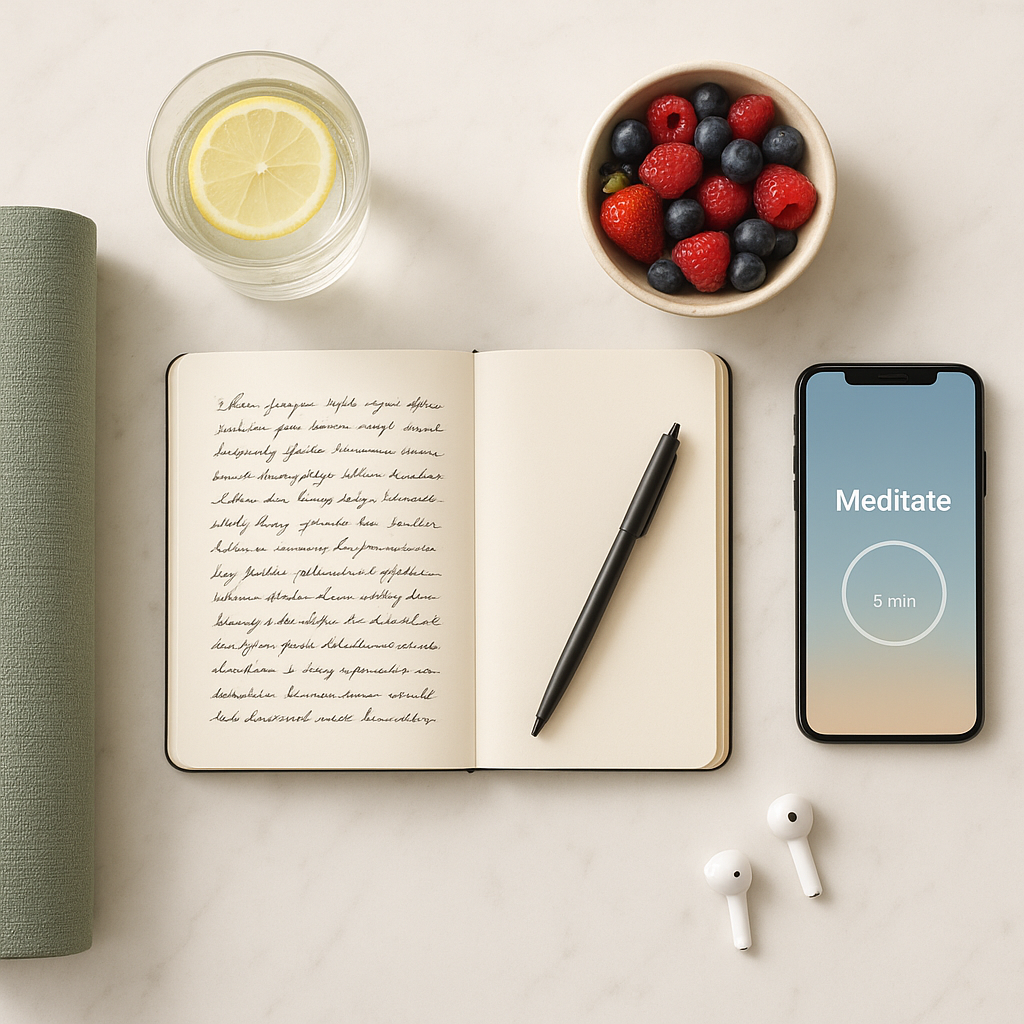
How to Build a Morning Ritual That Actually Sticks
Starting well is one thing. The real challenge is consistency. Here are evidence-backed strategies for building a morning ritual that lasts beyond the initial enthusiasm:
- Start impossibly small. A two-minute version of any habit is infinitely better than a 30-minute version you never actually do. Begin with what feels almost too easy.
- Anchor new habits to existing ones. Habit stacking — attaching a new behaviour to something you already do automatically — dramatically increases follow-through. For example: “After I make coffee, I will write one thing I’m grateful for.”
- Prepare the night before. Lay out your exercise clothes, set out your journal, prep your breakfast ingredients. Reducing friction in the morning makes it easier to follow through on intentions.
- Protect your wake time. Waking at a consistent time — even on weekends — is one of the most powerful levers for overall wellbeing. It anchors everything else.
- Expect imperfection. Missing a day doesn’t mean failure. Research by health psychologist Phillippa Lally found that missing an occasional day has no meaningful effect on long-term habit formation. The key is returning to the ritual without self-judgment.
Common Misconceptions About Morning Routines
It’s worth addressing a few myths that tend to circulate around this topic.
Myth: You need to wake up extremely early. The research doesn’t support a specific wake time as being universally superior. What matters is consistency, not the hour on the clock. A morning ritual that begins at 7:30am is no less valid than one that starts at 5:00am.
Myth: More is always better. A jam-packed routine filled with 15 different habits is likely to be unsustainable and stressful — which defeats the entire purpose. Two or three anchoring rituals done consistently are worth far more than an elaborate system that collapses under pressure.
Myth: If it works for someone else, it will work for you. Morning routines are deeply personal. A cold shower might invigorate one person and genuinely distress another. Yoga might be transformative for someone and completely unappealing to someone else. The goal is to find what genuinely works for your body, mind, and life — not to replicate anyone else’s blueprint.
The Ripple Effect: How Mornings Shape the Whole Day
One of the most striking aspects of morning rituals is how their influence extends far beyond the morning itself. Research from Adelson Psychiatry and other behavioural health organisations suggests that how we begin the day creates a psychological momentum that shapes our decisions, energy levels, and emotional responses for hours afterwards.
When someone has moved their body, eaten well, spent a few quiet moments with their thoughts, and protected their attention from reactive screen use — they arrive at their work, their relationships, and their responsibilities in a fundamentally different state than someone who woke up anxious, rushed, and immediately overwhelmed by notifications.
This isn’t a small difference. Over weeks and months, the cumulative effect of starting each day from a centred, intentional place — rather than a reactive, depleted one — is genuinely significant for long-term wellbeing.
In Summary
Morning rituals earn their reputation not through mysticism or wellness marketing, but through well-supported psychological and physiological mechanisms. They reduce decision fatigue, stabilise mood, regulate the body’s internal clock, and create a sense of agency and calm that ripples outward through the entire day.
The key insights worth carrying forward are these: consistency matters more than perfection; simplicity outperforms complexity; the morning window is uniquely powerful due to cortisol rhythms and natural willpower peaks; and protecting that window from reactive screen use is one of the most high-impact changes most people can make.
Whether your ritual takes five minutes or an hour, whether it involves movement or stillness, food or fasting — the act of beginning the day with intention rather than inertia is, in itself, a form of self-care. And over time, that daily act of choosing how you start has a way of quietly changing everything else.